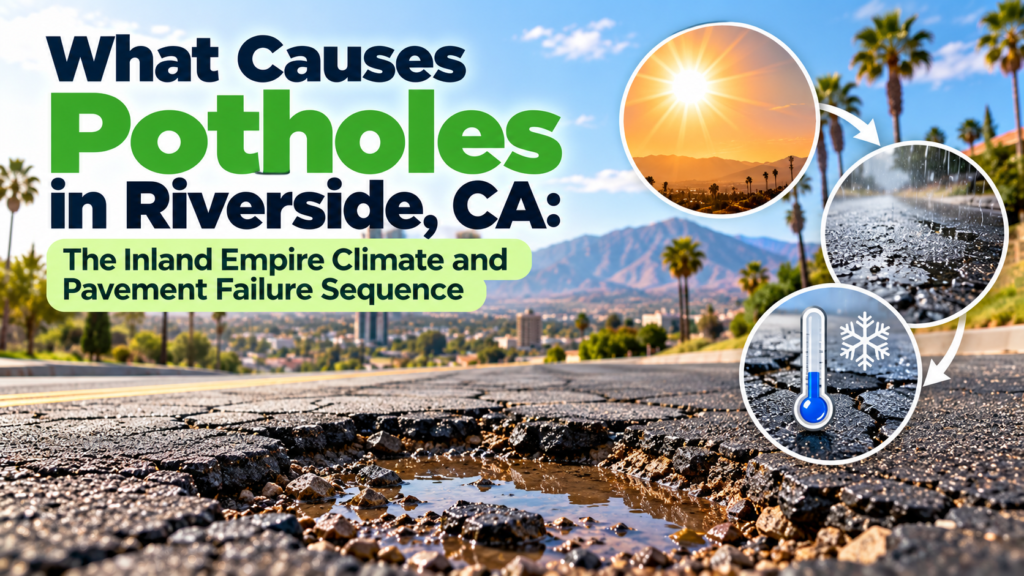
Potholes are not random failures. They are the end point of a specific deterioration sequence that begins with surface cracking, progresses through moisture infiltration and subbase weakening, and culminates in the complete loss of surface support that produces the bowl-shaped cavity visible at the surface. In Riverside, California, the conditions that drive this sequence are well understood: intense solar radiation that ages asphalt binder, occasional winter rainfall that infiltrates cracked pavement, winter temperature drops that cause freeze-thaw cycling in elevated areas, and heavy vehicle traffic that delivers the final load that punches through a weakened surface.
Understanding the pothole formation process in the specific context of Riverside’s Inland Empire climate helps property owners and pavement managers recognize early warning signs, understand why some locations in the city are more prone to Asphalt Potholes Riverside than others, and know what stages of the deterioration process can still be interrupted by maintenance before full pothole formation occurs.
Stage One: Asphalt Surface Oxidation and Initial Cracking
Potholes begin with the aging of the asphalt binder. Riverside’s climate is among the most aggressive in California for asphalt oxidation: UV radiation index in the Inland Empire is higher than coastal Southern California due to lower marine cloud cover, summer pavement surface temperatures regularly exceed 150 degrees Fahrenheit, and the dry desert air accelerates oxidation of the bituminous binder.
As the binder oxidizes, it loses the flexibility that allows asphalt to accommodate thermal movement and minor load deflections. The pavement surface develops hairline cracks first transverse thermal cracks from temperature cycling, then longitudinal cracks as traffic loading begins to flex the stiffened structure. These initial cracks are small and may not be immediately visible from vehicle speed, but they are the entry points for everything that follows.
Sealcoating at this stage before the binder has fully hardened and before cracks have opened significantly can arrest the deterioration sequence. Sealcoat blocks UV radiation, slows further oxidation, and seals micro-cracks before they develop into the larger openings that allow water infiltration. This is why asphalt maintenance professionals consistently emphasize the value of sealcoating on a regular schedule: the cost of prevention at this stage is a fraction of the cost of repair once potholes form.
Stage Two: Water Infiltration Through Cracks
Once cracks develop in the pavement surface, water infiltration begins. In Riverside, the primary water source is winter rainfall the city averages approximately 10 to 11 inches of annual precipitation, concentrated in November through March. A cracked pavement surface is not waterproof; even moderate rainfall infiltrates through crack networks and reaches the aggregate base and subgrade beneath.
Riverside’s native soils in the valley floor and foothills include expansive clays and silty soils derived from alluvial deposits of the Santa Ana River and its tributaries. These soils weaken significantly when saturated, losing bearing capacity that is only partially recovered when they dry out. Repeated wetting and drying cycles cause differential settlement that further disrupts the pavement structure above. Areas with high clay content in the subgrade are disproportionately represented in Riverside’s pothole inventory.
Irrigation is an underappreciated water source for pavement deterioration in Riverside. The city’s warm climate and landscaping culture mean that irrigation systems run year-round, and overspray onto pavement edges and infiltration along utility trenches from irrigation laterals are constant sources of subgrade moisture. Commercial properties with poorly adjusted irrigation systems can experience pothole formation at consistent locations that are not related to rainfall at all.
Stage Three: Freeze-Thaw Cycling in Elevated Riverside Locations
Riverside is a geographically varied city. The valley floor near the 91 Freeway corridor sits at approximately 800 to 1,000 feet elevation and rarely experiences freezing temperatures. The foothills and higher elevations in areas like Alessandro Heights and the Box Springs Mountain area can experience overnight lows below freezing on 10 to 20 nights per year.
In these elevated portions of Riverside, freeze-thaw cycling acts on water that has infiltrated through surface cracks into the aggregate base. When water in the base or subgrade freezes, it expands by nine percent, exerting pressure that pushes the pavement upward and widens the crack system. When temperatures rise and the ice melts, the water-saturated subgrade loses bearing capacity and the pavement settles. Repeated cycles of this expansion and contraction progressively break down the aggregate structure and create voids in the base.
Even in the valley floor where freezing is rare, the large temperature differential between night and day in Riverside 30 to 40 degrees Fahrenheit swing in spring and fall drives moisture movement in the pavement structure through matric suction, repeatedly wetting and partially drying the subgrade and contributing to the weakening process even without true freezing.
Stage Four: Traffic Loading and Pothole Punch-Through
The final stage of pothole formation is the mechanical failure that occurs when traffic loading is applied to a pavement section whose subbase has been weakened by moisture and whose surface is cracked and delaminated. The pavement section above the weakened zone lacks the support needed to distribute wheel loads to the underlying soil, and the surface deflects downward under each passing wheel.
With each load application, the cracked surface section flexes and breaks further. The loose aggregate pieces are dislodged by tire impact and carried away. Once the aggregate in the base has displaced sufficiently, the surface above it collapses, forming the characteristic pothole cavity. Heavy vehicles delivery trucks, buses, waste collection vehicles accelerate this process dramatically compared to passenger cars, because their axle loads are many times higher and they apply more energy per pass to the weakened pavement structure.
In Riverside’s commercial corridors particularly on streets with high truck traffic such as those serving industrial zones in the Eastside and near the airport potholes form rapidly once base weakening begins because the load spectrum is heavily weighted toward commercial vehicles. The same crack pattern that might take five years to develop into a pothole on a residential street can progress to a pothole in a single rainy season on a heavily trafficked commercial road.
Why Potholes Cluster in Specific Riverside Locations
Potholes do not distribute randomly across a pavement surface. They cluster in locations where one or more of the predisposing conditions poor drainage, weak subgrade, high traffic loading, thin original pavement section are concentrated. Understanding these clustering patterns helps predict where potholes will form and where early intervention is most cost-effective.
Locations with concentrated water flow low points in parking lots, areas where curb and gutter drainage is blocked, ends of driveways that collect runoff from adjacent landscaping develop potholes because water has the most time to infiltrate and weaken the subgrade. Utility trench cuts are another pothole-prone location: the backfill in utility trenches is often less well compacted than the surrounding undisturbed base, creating a zone of differential settlement that concentrates stress and cracking at the trench edges.
Bus stops and intersections in Riverside concentrate both the heaviest traffic loads (buses, left-turn movements) and the highest pavement temperatures from idling vehicles, making them among the most pothole-prone locations in commercial and transit corridors.
Temporary vs. Permanent Pothole Repair Methods
Cold-patch asphalt repair the proprietary pre-mixed asphalt material used for temporary pothole repair is a maintenance measure that addresses the immediate surface cavity but does not restore structural capacity to the damaged base. Cold-patch repairs in Riverside typically last one to two seasons before the repair fails and the pothole re-forms, because the underlying cause weakened subbase has not been addressed.
Permanent pothole repair involves full-depth patching: removing the failed asphalt and the weakened base material, compacting new aggregate base in lifts, and replacing with hot-mix asphalt compacted to the same density as the surrounding pavement. Full-depth patches properly executed in Riverside can last ten or more years because they address the complete failure zone rather than just the surface expression.
Frequently Asked Questions: Potholes in Riverside, CA
Why does Riverside get potholes if it rarely freezes?
Potholes in Riverside’s lower elevations form primarily through UV-driven binder oxidation, crack-enabled water infiltration during winter rains, subgrade weakening from clay soils and irrigation water, and heavy vehicle traffic not freeze-thaw. Freeze-thaw contributes in Riverside’s higher-elevation neighborhoods.
Why do potholes form at the same spot year after year?
Recurrent potholes indicate that the underlying cause weak subgrade, poor drainage, inadequate base thickness has not been addressed. Temporary surface repairs do not correct these structural deficiencies.
What role does irrigation play in pothole formation in Riverside?
Irrigation overspray onto pavement edges and water infiltrating from nearby irrigation laterals keep subgrade soils wet in areas where rainfall alone would not. This moisture weakens subgrade bearing capacity and mimics the conditions freeze-thaw creates in colder climates.
How quickly can a pothole form in Riverside after cracks appear?
In a dry year with minimal rainfall and light traffic, a cracked pavement surface can remain stable for several seasons. In a wet winter with heavy rainfall and significant truck traffic, the progression from surface cracking to pothole formation can occur within a single rainy season.
Can potholes be permanently repaired without full pavement replacement?
Yes, with full-depth patching that removes all failed material both asphalt and weakened base and replaces it with properly compacted aggregate base and hot-mix asphalt. Surface-only repairs are temporary. Full-depth patches addressing the complete failure zone can be as durable as the surrounding pavement.
Potholes in Riverside are predictable, not random. They develop through a specific sequence of oxidation, cracking, moisture infiltration, subgrade weakening, and load-induced failure. Recognizing the early stages of this sequence surface cracking and oxidation and intervening with sealcoating and crack sealing interrupts the process before it reaches the pothole stage. Where the sequence has progressed to structural failure, full-depth patching restores the pavement rather than temporarily masking the damage.